


- Why an Exchanger Has Not Detected Your BTC, ETH, or USDT Transfer
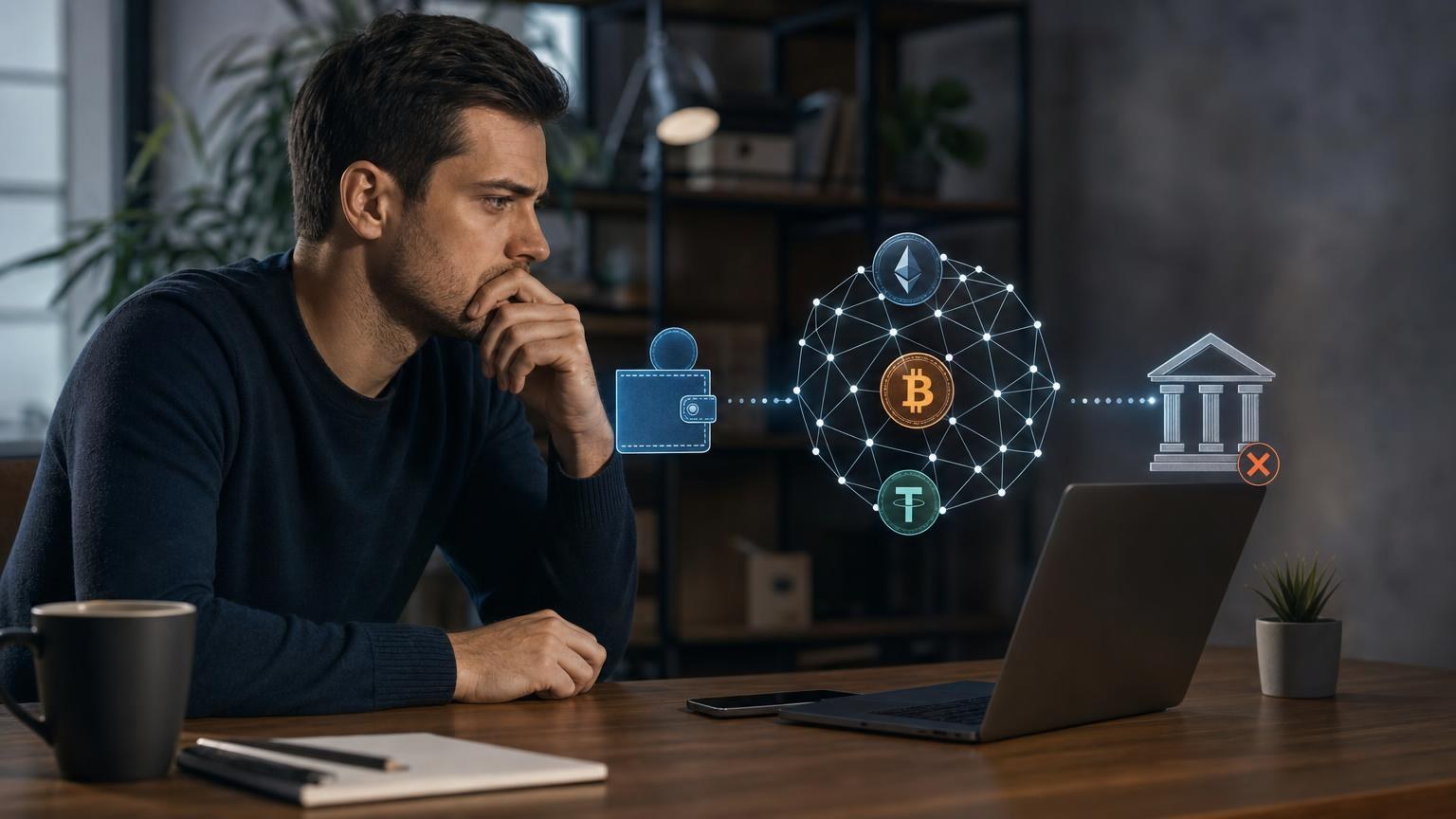
A transfer can leave your wallet without appearing immediately in an exchanger’s order. The delay usually occurs at one of four boundaries: the wallet has not broadcast the transaction, the network has not confirmed it, the exchanger has not yet indexed or credited it, or the asset was sent through a network or token contract that the receiving order does not support. The safest response is to identify the transaction on the correct blockchain before attempting any remedy.
Compact knowledge map: proof of broadcast → asset, network, and address match → blockchain status → confirmation policy → exchanger processing → support escalation. Each node answers a different question, so a wallet notification alone cannot replace the full check.
- Route 1 — Understand quickly: proof of broadcast → blockchain status → exchanger processing. Result: you can distinguish a normal wait from a transfer that requires attention.
- Route 2 — Prepare for practical action: transaction hash → correct explorer → address and network match → evidence for support. Result: you can submit a useful support request without exposing wallet secrets.
- Route 3 — Understand technically: mempool or transaction pool → block inclusion → confirmations or finality → token contract events → service indexing. Result: you can see why “sent,” “confirmed,” and “credited” are separate states.
Node 1: Prove That an Onchain Transaction Exists
Start with the transaction hash, also called a transaction ID or TXID. This identifier is generated when a transaction is submitted to a blockchain network. A receiving service normally needs it to locate the payment independently of what the sender’s wallet displays.
- Open the sending wallet or the withdrawal history of the platform from which you sent the funds.
- Find the relevant operation and copy its transaction hash.
- Confirm that you copied a blockchain transaction hash rather than an order number, withdrawal request ID, or account reference.
- Search for the hash in a block explorer for the network you selected.
If there is no transaction hash, the wallet may still be preparing or broadcasting the transfer. A centralized sending platform may also show a withdrawal as accepted while processing it internally. In that situation, the receiving exchanger cannot detect an onchain payment that does not yet exist on the relevant blockchain.
Ethereum’s official documentation describes a transaction as moving from submission and broadcast into a pool of pending transactions before a validator includes it in a block. Ethereum block explorers can show the hash, status, block, sender, recipient, transferred tokens, and fee. [1]
Node 2: Match the Asset, Network, Address, and Token Contract
A visible transaction is not enough. It must represent the asset and network requested by the exchanger’s order. This is especially important for USDT because Tether tokens exist on multiple blockchains and protocols. A deposit address that looks structurally compatible with more than one network does not prove that the receiving service supports all of them. Tether’s official materials instruct integrators to state explicitly which protocols they support. [2]
Fields to compare with the original exchange order Field What to verify Why it matters Asset BTC, ETH, or the exact token requested A service cannot credit one asset as another merely because the destination address appears valid. Network The sending network must match the network stated in the order USDT on Ethereum, Tron, and other supported protocols consists of separate onchain transfers. Recipient Compare the complete receiving address, not only its first or last characters Clipboard malware and address-poisoning attacks can substitute a similar-looking address. Token contract For token transfers, verify the contract shown by the explorer Different or counterfeit tokens can use the same ticker symbol. Amount Compare the transferred amount with the order details Network fees, wallet settings, or a partial withdrawal may cause a mismatch that needs review. Do not send a second payment merely because the first one is missing from the exchanger interface. First determine where the original transfer went. Confirmed blockchain transactions are generally not reversible by a wallet provider or explorer. Bitcoin’s safety guidance specifically recommends checking the entire destination address and never sharing a seed phrase or private key with someone claiming to provide support. [3]
Node 3: Interpret the Blockchain Status Correctly
The explorer status determines the next step. The labels differ across networks and explorers, but the underlying states can be grouped into four cases.
Transaction not found
Check that the hash was copied correctly and that you are using an explorer for the selected network. If the hash is still absent, contact the sending wallet or platform. Ask whether the withdrawal has been broadcast and request the actual onchain transaction hash. The receiving exchanger has little evidence to investigate until a transaction becomes visible on the expected network.
Pending or unconfirmed
The transaction has reached the network but has not yet been included in a block. With Bitcoin, a fee below the level miners are currently prioritizing can make the first confirmation take longer. Bitcoin block production is probabilistic, so no exact minimum or maximum confirmation time can be guaranteed. [3]
On Ethereum, pending transactions wait in a transaction pool until a validator selects and includes them. Fee settings and earlier transactions from the same sending account can affect processing. Do not attempt to replace or cancel a transaction unless your wallet explicitly supports that action and you understand how it treats the transaction nonce and fee. A poorly planned replacement can create additional confusion without recovering a transfer sent to an incorrect address.
Failed
A failed Ethereum transaction did not complete the intended state change, even though the attempt can remain recorded onchain and consume a network fee. Check the explorer’s token-transfer section rather than assuming that the wallet’s “sent” label proves USDT reached the recipient. If no successful token transfer to the exchanger’s address appears, provide the failed transaction hash to the sending wallet’s support team.
Successful or confirmed
This means the blockchain has processed the transaction. It does not automatically mean the exchanger has credited the order. Compare the recipient, network, asset, token contract, and amount before moving to the service-processing checks.
Technical distinction: inclusion, confirmations, and finality
For Bitcoin, the first confirmation occurs when miners include the transaction in a block. Every subsequent block adds another confirmation and reduces the likelihood of reversal. Each recipient decides how many confirmations it requires, so an exchanger’s threshold may differ by asset, amount, network conditions, and risk controls. [3]
On Ethereum, inclusion in a block is followed by consensus stages described as justified and finalized. Block explorers may also show execution success before a receiving platform completes its own indexing and account-crediting process. [4]
Node 4: Separate Network Confirmation From Exchanger Credit
An exchanger does not usually rely on the sender’s wallet notification. Its systems monitor supported networks, associate receiving addresses with active orders, wait for the required confirmation state, and then perform internal checks before updating the order.
A confirmed transaction may remain uncredited when:
- the exchanger is waiting for additional confirmations;
- its blockchain node or indexing system is catching up;
- the transaction arrived after the order’s displayed processing window or requires manual matching;
- the amount or asset does not match the order details;
- the payment used an unavailable network or an unsupported token contract;
- the operation has entered a compliance review.
Confirmation thresholds and compliance requirements are operational conditions, not universal blockchain rules. They can vary by exchange direction and by the outcome of applicable checks. Review the current order instructions and requirements rather than relying on a confirmation number remembered from an earlier transaction.
For USDT, “confirmed” only answers whether a particular blockchain processed the token transfer. The receiving service must also support that USDT network and recognize the relevant token contract. Sending through a different network is not converted automatically into the network selected in the order.
Node 5: Choose the Correct Action Without Increasing the Risk
Use the following procedure once you know the explorer status:
- No hash: ask the sender or withdrawal platform for proof that the transaction was broadcast.
- Hash not found: verify the network, recopy the hash, and check whether the sending platform replaced or cancelled the withdrawal.
- Pending: monitor the explorer. Use fee-management features only through the original wallet and only if you understand the available method.
- Failed: confirm whether any asset actually moved. A network fee may have been charged even if the intended transfer failed.
- Confirmed to the correct address and network: compare the confirmation count and order requirements, then contact the exchanger if the expected processing condition has already been met.
- Confirmed on the wrong network or to the wrong address: stop sending additional funds. Contact the entity controlling the destination address, but do not assume recovery is technically possible.
Never disclose a seed phrase, private key, wallet backup, authentication code, or remote access to your device. Genuine transaction investigation requires public information such as the transaction hash, receiving address, network, asset, amount, and order identifier. Be suspicious of unsolicited messages offering “recovery” in exchange for another crypto payment.
Evidence to Send to Support
A concise support request is easier to investigate than a screenshot saying only that funds are missing. Include:
- the exchange order identifier;
- the transaction hash in plain text;
- the asset and selected network;
- the complete receiving address shown in the order;
- the amount sent;
- the explorer status and current confirmation information;
- the approximate submission time with the time zone;
- a screenshot of the wallet or withdrawal record with sensitive account details hidden.
Do not alter the transaction evidence or crop out the fields needed to compare the payment with the order. At the same time, remove balances, email addresses, phone numbers, backup phrases, QR codes containing secrets, and unrelated transaction history.
Practical Check Before Creating or Repeating an Order
BTC, ETH, and USDT are among the assets supported by the service, but the availability of a particular exchange direction, receiving network, or pair must be verified before sending. Check the order page rather than assuming that support for an asset means support for every blockchain on which it can circulate. You can check the currently available exchange directions and network requirements before creating a new order.
For a future transfer, copy the address from the active order, verify the complete address and network in both interfaces, and consider a small test transfer when the service rules and total network costs make that practical. Remember that crypto prices can change while a delayed order is being resolved; do not make a second transfer solely to compensate for market movement. The immediate goal is to establish one verifiable chain of facts: broadcast transaction, correct network, correct destination, sufficient confirmation state, and successful matching by the exchanger.
- How to Check a Monero Address Before Exchanging XMR

Before sending XMR, you should be able to confirm four things: Monero is the selected asset, the destination is a valid address for the intended Monero network, every required recipient field came from a trusted source, and the amount matches the exchange request. This guide walks through those checks using a neutral example, without displaying a real address or asking you to expose private wallet information.
What you need to know before checking the address
A Monero address is a public destination used to receive XMR. Sharing it does not give another person control of the wallet. A seed phrase and private keys are different: they provide access to funds and must never be entered into an exchange order, address validator, support chat, or block explorer.
Monero supports several public address types. A standard address is the wallet’s primary address, a subaddress is commonly used for individual incoming payments, and an integrated address can contain a compact payment identifier. Official Monero documentation recommends subaddresses as the usual receiving option for individuals. [1]
You can think of the recipient address as a delivery label. The analogy is useful because both must identify the intended destination exactly. Its limit is important: a blockchain transaction does not have a postal service that can redirect a package after a typing mistake. Once a valid transaction has been broadcast, it generally cannot be edited or recalled by the sender.
How to validate a Monero address
Start with the wallet or exchange interface that will send the XMR. A suitable Monero wallet should parse the address, identify its address type and network, and verify its built-in checksum. The checksum helps software detect invalid changes or typing errors, but it does not prove that a valid address belongs to the person or service you intend to pay. [2]
- Get the address from the intended recipient. For an exchange payout, generate or copy a receiving address from your own Monero wallet. For a deposit, use only the address shown in the active order or deposit screen.
- Confirm the asset. The sending side must show XMR or Monero. Do not treat an address field accepting pasted text as proof that the correct asset is selected.
- Check the network. Normal transfers involving real XMR use Monero mainnet. Monero also has separate stagenet and testnet blockchains for learning and development; their coins are not mainnet XMR. [3]
- Let the sending wallet validate the address. Stop if it reports an invalid checksum, unsupported address type, or wrong network. Do not remove characters to make the warning disappear.
- Compare the displayed address with the original. Check more than the first and last few characters. Clipboard-replacing malware can create a different but correctly formatted address, so compare several groups across the full string or use a trusted QR code.
- Confirm any additional identifier. Do not invent a Memo, Tag, or payment identifier. If the receiving service supplies one separately, follow its current instructions exactly. An integrated Monero address may already contain a compact payment ID, while long standalone payment IDs are no longer supported by current Monero transactions. [1]
Anatomy of a sample exchange operation
Consider a fictional operation in which a beginner exchanges another supported asset for XMR and asks for the XMR to be delivered to a personal wallet. No actual price, fee, limit, or address is used in this example.
Selected asset
The output asset is XMR. This tells the exchange what the user expects to receive. It comes from the order form and must match the receiving wallet. Selecting a similarly named asset or another cryptocurrency would create a mismatch before the address is even considered.
Selected network
The payout network is Monero mainnet. The user checks it against the wallet’s network and the exchange order. A testnet or stagenet address belongs to a separate blockchain, while an unrelated network is not a substitute for Monero. Availability of a particular exchange direction or network should always be checked before creating the order.
Recipient address
The recipient address is generated inside the user’s Monero wallet, preferably as a fresh receiving subaddress when the wallet supports that workflow. The user copies it into the payout field and then compares the pasted value with the wallet display. A checksum-valid address can still belong to an attacker or the wrong recipient, so software validation and visual comparison solve different problems.
Memo, Tag, or payment identifier
In this sample payout, the wallet provides only a Monero subaddress, so the user does not add a Memo or Tag. If an order instead presents an integrated address, its compact payment identifier is included in that address. If a service explicitly displays a separate required field, the value must come from that service rather than from guesswork. Omitting a required identifier may prevent the service from assigning a deposit to the correct order even when funds reach its wallet.
Amount, rate, and fee
The order screen displays the amount to send, an estimated or fixed exchange rate according to the stated order terms, any disclosed fee, and the resulting XMR amount. The user checks which amount is the deposit and which is the expected payout. These values come from the live order, not from a general article, and may change depending on the exchange direction and its conditions.
Before proceeding, the user should also review whether the shown payout is an estimate or a final quoted amount and whether any network cost is already included. No assumption about fees should replace the figures and terms displayed for the specific operation.
Status and transaction ID
After the transaction is sent, the order status may move through stages such as waiting for a deposit, processing, or completed, depending on the service interface. A transaction ID, often called a txid, identifies a blockchain transaction and can help a wallet scan for a missing transfer. It does not reveal a seed phrase and does not itself give control over funds. [4]
For a practical attempt, the user can check the currently available XMR exchange direction and order fields before transferring anything. Although XMR is among the supported assets, a specific pair or route should not be assumed to be active. Current requirements may also vary with the operation and the outcome of applicable compliance checks, so they should be reviewed before creating the order.
Pause before the irreversible step
Do not confirm the transfer until you can explain each relevant field in plain language. You should be able to say:
- “I am sending or receiving XMR, not another asset.”
- “This address came from my wallet or the active recipient order.”
- “The address is accepted as a Monero mainnet address by the sending wallet.”
- “The pasted address still matches the source across several sections.”
- “I know whether an additional identifier is required, embedded, or not applicable.”
- “I understand the amount I must send and the amount the order currently shows as the payout.”
- “I saved the order reference and will retain the txid if a transaction is broadcast.”
If one of these statements is unclear, leave the confirmation screen and check the original wallet or order details again. Never resolve uncertainty by sending a seed phrase, private key, or wallet file to someone offering support.
Common address mistakes and how to prevent them
The address changes after pasting
How it looks: the beginning may appear familiar, but characters in the middle or end differ from the wallet display. Why it happens: the wrong item was copied, the address was truncated, or clipboard malware replaced it. What to do before sending: clear the field, copy again from the wallet, compare multiple sections, and investigate the device if the substitution repeats.
The wallet says the address is invalid
How it looks: the confirmation button remains unavailable or a checksum, format, or network warning appears. Why it happens: a character is missing, extra text was copied, or the address belongs to another Monero network. What to do before sending: obtain the address again from its source. Do not manually alter characters or use an unknown website that asks for sensitive wallet information.
A Memo or Tag field appears unexpectedly
How it looks: the form requests an extra identifier even though the personal wallet displayed only an address. Why it happens: the form may be generic, or the receiving service may use an order-specific deposit process. What to do before sending: read the instructions for that exact order. Leave an optional field empty only when the interface permits it and the recipient does not require a value.
The address is valid but belongs to the wrong recipient
How it looks: the wallet accepts the address without warning. Why it happens: validity checks confirm structure and checksum, not ownership or intent. What to do before sending: verify the address through the recipient’s trusted interface or a second trusted communication channel. Be cautious with addresses received through unsolicited messages, advertisements, or copied support accounts.
The order details no longer match the transfer
How it looks: the amount, exchange direction, deposit instructions, or order status differs from what was recorded earlier. Why it happens: the order may have expired, been recreated, or been opened in another session. What to do before sending: stop and use the current order screen. Do not transfer funds to an old address merely because it was used in a previous operation.
A short first-check algorithm
- Open the intended Monero wallet or active exchange order directly, avoiding links from unexpected messages.
- Confirm that the asset is XMR and that the operation uses Monero mainnet.
- Copy the recipient address from its trusted source and paste it once.
- Wait for the wallet or exchange interface to validate the address format and checksum.
- Compare several sections of the pasted address with the original or rescan a trusted QR code.
- Check whether any Memo, Tag, or payment identifier is actually required.
- Review the send amount, displayed payout, rate terms, disclosed fee, and order status.
- Pause, repeat the destination and amounts in your own words, then confirm only if every field is clear.
- Save the order reference and txid without sharing private wallet credentials.
This process reduces common errors but cannot provide complete safety. Device compromise, phishing, incorrect recipient instructions, price volatility, and differing legal or compliance rules across countries can still affect an exchange. A small test transfer may be useful when both sides permit it, but it does not replace checking every field again for the final transaction.
- Coronavirus disease 2019
COVID-19 is a contagious disease caused by the coronavirus SARS-CoV-2. In January 2020, the disease spread worldwide, resulting in the COVID-19 pandemic.
The symptoms of COVID‑19 can vary but often include fever,[7] fatigue, cough, breathing difficulties, loss of smell, and loss of taste.[8][9][10] Symptoms may begin one to fourteen days after exposure to the virus. At least a third of people who are infected do not develop noticeable symptoms.[11][12] Of those who develop symptoms noticeable enough to be classified as patients, most (81%) develop mild to moderate symptoms (up to mild pneumonia), while 14% develop severe symptoms (dyspnea, hypoxia, or more than 50% lung involvement on imaging), and 5% develop critical symptoms (respiratory failure, shock, or multiorgan dysfunction).[13] Older people have a higher risk of developing severe symptoms. Some complications result in death. Some people continue to experience a range of effects (long COVID) for months or years after infection, and damage to organs has been observed.[14] Multi-year studies on the long-term effects are ongoing.[15]
COVID‑19 transmission occurs when infectious particles are breathed in or come into contact with the eyes, nose, or mouth. The risk is highest when people are in close proximity, but small airborne particles containing the virus can remain suspended in the air and travel over longer distances, particularly indoors. Transmission can also occur when people touch their eyes, nose, or mouth after touching surfaces or objects that have been contaminated by the virus. People remain contagious for up to 20 days and can spread the virus even if they do not develop symptoms.[16]
Testing methods for COVID-19 to detect the virus's nucleic acid include real-time reverse transcription polymerase chain reaction (RT‑PCR),[17][18] transcription-mediated amplification,[17][18][19] and reverse transcription loop-mediated isothermal amplification (RT‑LAMP)[17][18] from a nasopharyngeal swab.[20]
Several COVID-19 vaccines have been approved and distributed in various countries, many of which have initiated mass vaccination campaigns. Other preventive measures include physical or social distancing, quarantining, ventilation of indoor spaces, use of face masks or coverings in public, covering coughs and sneezes, hand washing, and keeping unwashed hands away from the face. While drugs have been developed to inhibit the virus, the primary treatment is still symptomatic, managing the disease through supportive care, isolation, and experimental measures.
- Coronavirus disease 2019
COVID-19 is a contagious disease caused by the coronavirus SARS-CoV-2. In January 2020, the disease spread worldwide, resulting in the COVID-19 pandemic.
The symptoms of COVID‑19 can vary but often include fever,[7] fatigue, cough, breathing difficulties, loss of smell, and loss of taste.[8][9][10] Symptoms may begin one to fourteen days after exposure to the virus. At least a third of people who are infected do not develop noticeable symptoms.[11][12] Of those who develop symptoms noticeable enough to be classified as patients, most (81%) develop mild to moderate symptoms (up to mild pneumonia), while 14% develop severe symptoms (dyspnea, hypoxia, or more than 50% lung involvement on imaging), and 5% develop critical symptoms (respiratory failure, shock, or multiorgan dysfunction).[13] Older people have a higher risk of developing severe symptoms. Some complications result in death. Some people continue to experience a range of effects (long COVID) for months or years after infection, and damage to organs has been observed.[14] Multi-year studies on the long-term effects are ongoing.[15]
COVID‑19 transmission occurs when infectious particles are breathed in or come into contact with the eyes, nose, or mouth. The risk is highest when people are in close proximity, but small airborne particles containing the virus can remain suspended in the air and travel over longer distances, particularly indoors. Transmission can also occur when people touch their eyes, nose, or mouth after touching surfaces or objects that have been contaminated by the virus. People remain contagious for up to 20 days and can spread the virus even if they do not develop symptoms.[16]
Testing methods for COVID-19 to detect the virus's nucleic acid include real-time reverse transcription polymerase chain reaction (RT‑PCR),[17][18] transcription-mediated amplification,[17][18][19] and reverse transcription loop-mediated isothermal amplification (RT‑LAMP)[17][18] from a nasopharyngeal swab.[20]
Several COVID-19 vaccines have been approved and distributed in various countries, many of which have initiated mass vaccination campaigns. Other preventive measures include physical or social distancing, quarantining, ventilation of indoor spaces, use of face masks or coverings in public, covering coughs and sneezes, hand washing, and keeping unwashed hands away from the face. While drugs have been developed to inhibit the virus, the primary treatment is still symptomatic, managing the disease through supportive care, isolation, and experimental measures.
- Segunda prueba
A ver que tal la segunda